









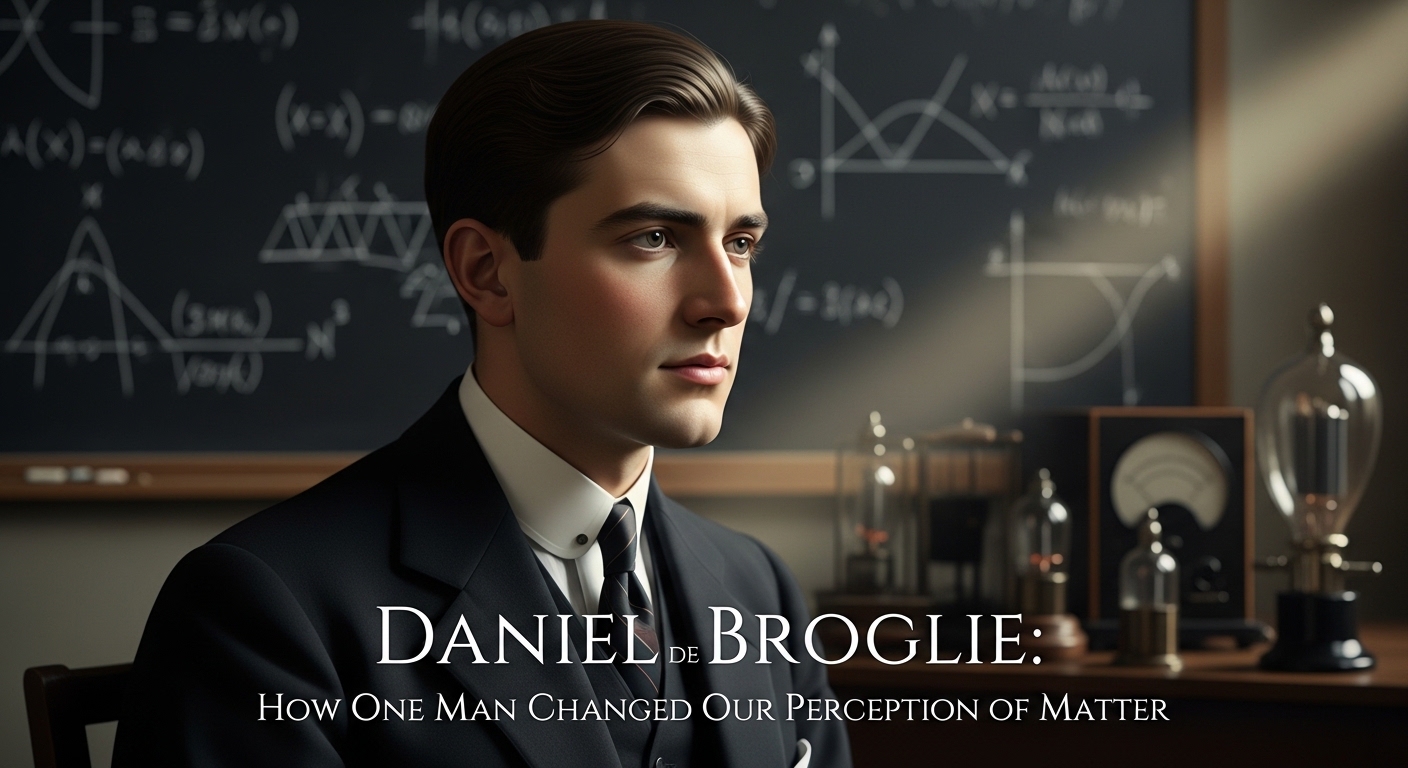
In the realm of physics, few names resonate with as much significance as Daniel Broglie. His groundbreaking ideas transformed our understanding of matter and paved the way for modern quantum mechanics. Imagine a world where particles aren’t just tiny bits of matter but also exhibit wave-like properties. This revolutionary concept altered how scientists perceive the fabric of reality itself.
Broglie’s work challenged traditional notions and opened up new avenues in scientific thought. With his insights, he not only contributed to theoretical advancements but also inspired generations of physicists to explore uncharted territories in their quest for knowledge. Journey with us through the life and legacy of this remarkable thinker who forever changed our perception of the universe’s building blocks.
Who is Daniel broglie?
Daniel Broglie was a French physicist who revolutionized our understanding of matter. Born on August 13, 1892, in Dieppe, France, he is best known for his groundbreaking theory of wave-particle duality.
His work suggested that particles such as electrons exhibit both wave-like and particle-like properties. This idea challenged the classical Newtonian view of physics and opened new avenues in quantum mechanics.
Broglie’s insights laid the groundwork for future scientists to explore the complexities of atomic behavior. His contributions earned him the Nobel Prize in Physics in 1929.
He spent much of his career advocating for scientific research and education. His ideas continue to influence modern physics, making him a pivotal figure in science’s evolution over the last century.
Early Life and Education
Daniel Broglie was born on August 15, 1892, in Dieppe, France. His family had a rich intellectual tradition. This environment nurtured his curiosity from an early age.
After completing high school, he pursued higher education at the University of Paris. There, he studied physics and mathematics subjects that would later shape his groundbreaking theories.
Broglie’s passion for science deepened during his university years. He immersed himself in the works of great physicists like Einstein and Planck. Their ideas challenged him to think critically about matter and energy.
He earned his doctorate in 1924 with a thesis that introduced concepts far ahead of its time. This academic foundation laid the groundwork for what would become one of the most significant scientific breakthroughs in history: wave-particle duality.
Discovering the Wave-Particle Duality
In the early 20th century, physics was on the brink of a revolution. Daniel Broglie’s groundbreaking idea introduced a fresh perspective on matter and light.
He proposed that particles, like electrons, could exhibit properties of both waves and particles. This concept shook the foundations of classical physics. Scientists were accustomed to viewing these entities in strictly defined roles.
Broglie’s hypothesis stemmed from his fascination with wave phenomena observed in light. He ingeniously suggested that if light could behave as a particle photons then perhaps matter could do the same.
This wave-particle duality opened up new avenues for understanding atomic behavior. It led to experiments confirming that electron diffraction patterns resembled those of waves, showcasing their dual nature. His insights set off a chain reaction within quantum mechanics that would redefine scientific thought for generations to come.
The Impact of Broglie’s Work on Quantum Physics
Daniel Broglie’s groundbreaking work redefined our understanding of the microscopic world. His proposition that particles could exhibit both wave-like and particle-like behavior opened new avenues in quantum physics.
This wave-particle duality became a cornerstone of quantum mechanics. It challenged classical physics, which viewed matter purely as particles. Scientists had to rethink how they approached atomic and subatomic phenomena.
Broglie’s hypothesis laid the groundwork for subsequent theories, including Heisenberg’s uncertainty principle and Schrödinger’s wave equation. These concepts transformed the way physicists studied electrons and photons.
The implications extended beyond theoretical discussions; they influenced technologies such as semiconductors and lasers. Today, innovations in quantum computing owe much to Broglie’s insights.
His ideas continue to inspire researchers exploring the fundamental nature of reality, bridging gaps between various scientific disciplines. The ripples from his discoveries are felt even decades later across multiple fields within science.
Controversies and Criticisms
Daniel Broglie’s wave-particle duality theory sparked immense excitement in the scientific community but also drew skepticism. Some contemporaries questioned the validity of his ideas, suggesting that grounding particles in both wave and particle forms created unnecessary complexities.
Critics argued that defining matter through this dual lens blurred essential distinctions between classical physics and quantum mechanics. They wondered if this approach truly added value or merely complicated existing frameworks.
Broglie’s peers had mixed reactions, with some embracing his theories wholeheartedly while others resisted change. The clash of perspectives led to heated debates at conferences and in academic journals, contributing to a rich tapestry of discourse around quantum mechanics.
Despite these controversies, Broglie remained steadfast. His willingness to challenge conventional thought paved the way for further exploration into quantum behavior and inspired future generations of physicists to test boundaries even further.
Legacy and Influence on Modern Science
Daniel Broglie’s ideas sparked a revolutionary shift in how we perceive matter. His wave-particle duality concept became fundamental to quantum mechanics, altering the course of physics.
Today, his legacy is embedded in numerous scientific advancements. Technologies like electron microscopes and semiconductor devices owe their existence to principles derived from his work. These innovations have transformed industries and daily life.
Broglie’s influence extends beyond physics into other fields such as chemistry and material science. Researchers continue to explore his theories, seeking deeper understanding of atomic behavior.
His contributions also inspire new generations of scientists. Students worldwide study his principles, fostering curiosity about the universe’s nature.
The philosophical implications of Broglie’s work challenge our views on reality itself. As modern physicists grapple with concepts like entanglement and uncertainty, they stand on the shoulders of giants like Daniel Broglie.
Conclusion
Daniel Broglie’s contributions to science opened new avenues for understanding the universe. His proposition of wave-particle duality transformed our approach to quantum mechanics, challenging long-held beliefs about matter. While his theories sparked debates among contemporaries, they ultimately laid the groundwork for future advancements in physics.
Broglie’s legacy endures today. His ideas continue to influence research and inspire scientists worldwide. The concepts he introduced not only changed how we perceive matter but also reshaped the fabric of modern science itself. Understanding his work invites us into a deeper exploration of reality, where particles dance as waves and uncertainty reigns supreme.
The journey through Daniel Broglie’s life reflects determination and innovation a reminder that one person’s insight can alter humanity’s grasp on nature’s mysteries forever.